| Benefits of Online Learning: What Research Says (2026) |
Online learning has moved from a backup option to a mainstream way to study. Working professionals use it to upgrade their skills, students in smaller cities use it to reach programmes that are not available locally, and employers use it to train their teams.
But the benefits are not automatic. Research shows that online learning can work as well as classroom teaching, and also that many learners struggle to finish. This guide explains the benefits of online learning, what the evidence says, where the risks are, and what Pakistani learners should check before they enrol.
Key takeaways
- Flexibility and lower costs are the most practical benefits for working learners.
- A large US meta-analysis found that online students performed modestly better on average than classroom students, mainly in studies of adults.
- Employers tend to look at skills, experience and the reputation of the institution more than the study format.
- Completion is the biggest weakness: structure, deadlines and support make a real difference.
- In Pakistan, check recognition with HEC or your employer before you pay for any programme.
The Main Benefits of Online Learning
1. Flexibility that fits around work and family

The most common reason people choose online study is control over time. You can study in the evening, on weekends or between shifts, and you do not need a daily commute. That matters for working professionals, parents and caregivers, and for anyone who cannot leave a job to study full time.
Flexibility also builds useful habits. Planning study hours around other duties teaches prioritising, deadline management and self-discipline, which carry over to the workplace.
2. Lower overall cost

Online programmes can cut several costs that campus study adds on top of tuition: daily transport, relocation, hostel or rent, and printed textbooks. Many courses supply digital materials, and learners can often keep their income while they study.
Fees still vary a great deal between providers, so compare the full cost, including exam, certification and any extra fees, rather than assuming that online always means cheaper.
3. Access from anywhere
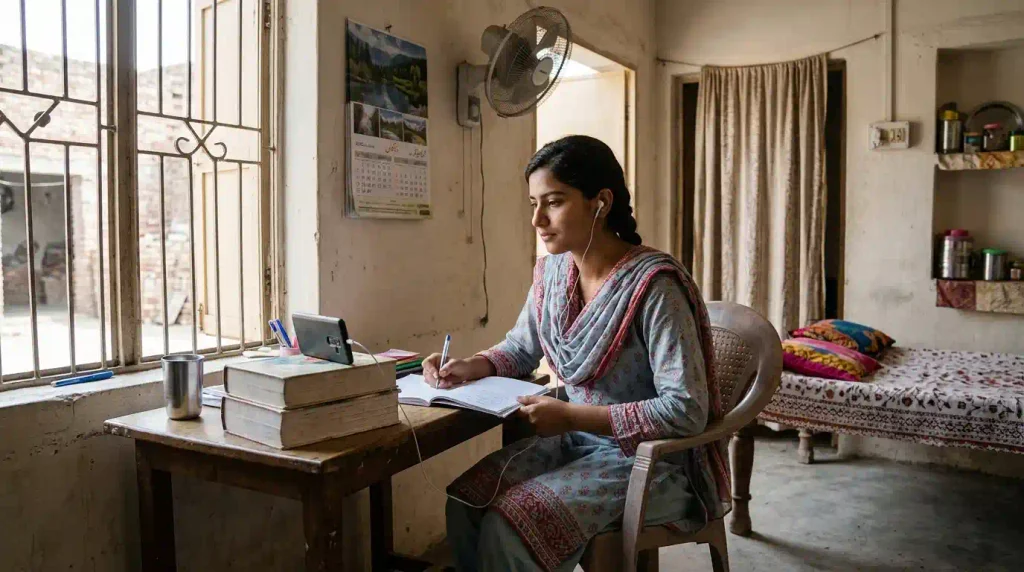
Online learning can reach people who live far from a university or training centre. The Higher Education Commission has described online and distance learning as a tool for equity that can bring higher education to underserved regions.
Connectivity is improving. The Pakistan Economic Survey 2025-26 reports about 161 million broadband subscriptions in March 2026, a penetration rate of 64.2%. Subscriptions are not the same as unique users, though. DataReportal counted 117 million internet users, or 45.6% of the population, at the end of 2025, and a GSMA report estimates that roughly 140 million people live within mobile coverage but do not use mobile internet. Access is wider than before, but it is not yet universal.
4. Self-paced and personalised learning
Online platforms let you slow down on difficult topics, replay recorded lectures and skip what you already know. Many courses mix video, readings, quizzes and discussion forums, so you can use the formats that suit you best. This is a real advantage for adults who already have experience in the subject and want to fill specific gaps.
5. Learning outcomes can match classroom teaching

The strongest evidence comes from a meta-analysis prepared for the US Department of Education, which reviewed studies from 1996 to 2008. It found that, on average, students in online conditions performed modestly better than students taught face to face. The advantage was clearer for blended learning, which combines online and in-person teaching, and the authors noted that blended courses often gave students extra learning time and materials.
Two cautions matter. First, the studies mostly involved adult learners such as undergraduates, graduate students and professionals, so the findings do not automatically apply to school-age children. Second, researchers at Columbia University’s Community College Research Center warned that, without extra support, online courses can be harder for low-income and underprepared students, and that dropout is often higher. Online learning works best for motivated adults who get good support.
6. Career and skills benefits
Studying online lets you keep working while you build new skills, which can help you change roles or move up. A US study by Ithaka S+R asked 543 hiring professionals to compare candidates and found that work experience and skills mattered far more than whether the degree was earned online. Online degrees did face a modest penalty, and the penalty was largest for degrees from out-of-state public institutions, so the study advises choosing a provider local employers already know.
The lesson is practical: the reputation and recognition of the provider matter more than the format. Choose a programme that employers in your field already trust, and be ready to show what you can do.
7. Better digital skills
Running an online course means using learning platforms, video calls, shared documents and digital tools. These are the same tools many workplaces now depend on, so confidence with them is a useful side benefit.
Challenges of Online Learning and How to Handle Them

Finishing the course
Completion is the biggest weakness of online learning. An analysis of 565 Harvard and MIT course runs on edX, covering 5.63 million learners, found that 52% of registrants never entered the course material, and completion had not improved over six years (Reich and Ruipérez-Valiente, Science, 2019). These were open, free courses, so they are not the same as a paid programme with support, but the lesson holds: learning that depends only on motivation often stalls.
Structure helps. One study of a course delivered in two versions found 45% retention with a fixed schedule against 13% for the self-paced version (Noponen et al., 2020, as summarised by Rework).
Isolation and limited feedback
Without classmates and in-person teachers, some learners feel alone or wait too long for answers. Choose programmes with named instructors, a way to ask questions and some live or group activity.
Connectivity and devices
A weak connection, power cuts or a shared phone can derail study. Download materials when you can, keep a backup connection, and ask the provider whether lessons work on mobile and offline.
Recognition in Pakistan
Recognition is the question Pakistani learners should ask first. The Higher Education Commission’s Open and Distance Learning policy sets minimum quality standards for universities, other than those that specialise in distance education, that offer degrees online. In June 2026, HEC also announced new rules for foreign degrees, warning that degrees earned through unapproved online or hybrid modes may face recognition problems, and said equivalence cases will continue to be assessed individually.
Those rules concern degrees. Professional diplomas and short courses are usually judged by employers and professional regulators instead, so ask the organisation you want to work for, or your regulator, whether it accepts the qualification before you pay.
How to Get the Most From an Online Course
- Set fixed study times. Put two or three sessions in your calendar each week and protect them.
- Break the course into small goals. Weekly targets are easier to keep than a vague plan to finish in six months.
- Use live sessions and deadlines. They give you the accountability that self-paced content lacks.
- Ask questions early. Contact instructors or classmates as soon as you are stuck.
- Apply what you learn. Use new skills at work straight away, since practice improves retention.
- Plan for technology problems. Keep downloads, charged devices and a backup connection ready.
How to Choose a Credible Online Programme

- Check recognition for your goal. For a degree, verify the institution and mode on the HEC website. For a diploma or short course, ask your employer or regulator.
- Verify the awarding body. Find out who issues the certificate and how an employer can verify it.
- Read the syllabus. Look for clear modules, learning outcomes and real assessments.
- Look at support. Check for instructors, deadlines, feedback and a way to contact the provider.
- Compare the full cost. Ask about every fee, including exams and certification.
- Read student feedback. Look for reviews you can check, not only testimonials on the provider’s own page.
Frequently Asked Questions
What are the main benefits of online learning?
The main benefits are flexibility, lower costs, access from any location, self-paced study and the chance to build skills while you keep working.
Is online learning effective?
Research suggests it can be. A US Department of Education meta-analysis found that online students performed modestly better than classroom students on average, mostly in studies of adults. Results depend on course design, support and the learner’s motivation.
Is online learning cheaper than classroom study?
Often, because you save on transport, relocation and housing, but fees differ widely. Compare the total cost, including exam and certification fees.
Are online degrees recognised in Pakistan?
It depends on the institution and mode. HEC has an Open and Distance Learning policy for universities, and it assesses foreign degree equivalence case by case. Verify the institution and mode on the HEC website before enrolling.
Is an online diploma the same as a degree?
No. A diploma is a shorter, skills-focused qualification. It can help your career, but it does not replace a degree or a professional licence, and acceptance depends on the employer or regulator.
How can I stay motivated in an online course?
Set fixed weekly study times, choose a programme with deadlines or live sessions, break the course into small goals and ask for help early.
Conclusion
Online learning offers flexibility, lower costs and wider access, and research shows it can deliver solid results for motivated adult learners. Its weak points are completion, support and recognition, so the best choice is a programme with structure, a verifiable certificate and acceptance in your field.
If you are considering a PDRi programme, start with the admission procedure, the fee structure and the online verification guide, then confirm with your employer or regulator that the qualification suits your goal. You can also read our guide to online diploma courses in Pakistan or visit the PDRi learning system.
Sources
- Means et al., Evaluation of Evidence-Based Practices in Online Learning (US Department of Education, 2009)
- Means et al., The Effectiveness of Online and Blended Learning, Teachers College Record (2013)
- Jaggars and Bailey, Effectiveness of Fully Online Courses for College Students (Columbia University CCRC, 2010)
- Ithaka S+R, Employers’ Perceptions of Online Credentials
- Rework: Course completion rates, citing Reich and Ruipérez-Valiente (Science, 2019) and Noponen et al. (2020)
- HEC: Open and Distance Learning (ODL) Policy
- HEC: Summit on Quality Assurance of Online and Distance Education (September 2025)
- ProPakistani: HEC announces new rules for recognition of foreign degrees (June 2026)
- INP-WealthPk: Broadband subscribers reach 161 million (Economic Survey 2025-26)
- DataReportal: Digital 2026 Pakistan
- PhoneWorld: Pakistan’s 140 million mobile internet usage gap (GSMA)