A Complete, Honest Guide for Distance Learners
If you’re searching for professional diploma courses in Pakistan, you’ve probably noticed the same problem everyone runs into: dozens of institutes claim to offer diplomas, but very few explain clearly what these diplomas actually are, how recognized they are, and what they cost once you add up admission fees, tuition, and courier charges.
This guide is written for exactly that gap — especially for working professionals studying at a distance, and for overseas Pakistanis in Saudi Arabia, Qatar and Bahrain who cannot sit in a physical classroom but still want a credible qualification to strengthen their CV or support a promotion case.
What Is a Professional Diploma Course?

A professional diploma is a structured qualification focused on practical, job-relevant skills in a specific field — business management, IT, engineering trades, education, hospitality, or healthcare support, for example. Unlike a general degree, it’s built around a defined set of competencies rather than broad academic theory.
In Pakistan’s education landscape, it helps to separate three different things that often get lumped together under the word “diploma”:
- Academic/HEC-regulated diplomas and degrees — awarded by HEC-recognized universities (public or private) through formal semester and credit-hour systems, following Pakistan’s national qualifications framework.
- Technical/vocational diplomas — regulated by bodies such as NAVTTC (National Vocational and Technical Training Commission) or provincial Trade Testing Boards, common in engineering trades and technical fields.
- Professional/capacity-building diplomas — issued by training institutes, consultancies, or international awarding bodies to certify practical skill and prior work experience. These sit outside Pakistan’s formal HEC/NAVTTC qualifications framework and are generally used for CV enhancement, internal promotion evidence, or private-sector credibility rather than as a legal prerequisite for regulated professions.
Professional Diploma vs Academic Diploma vs Certificate
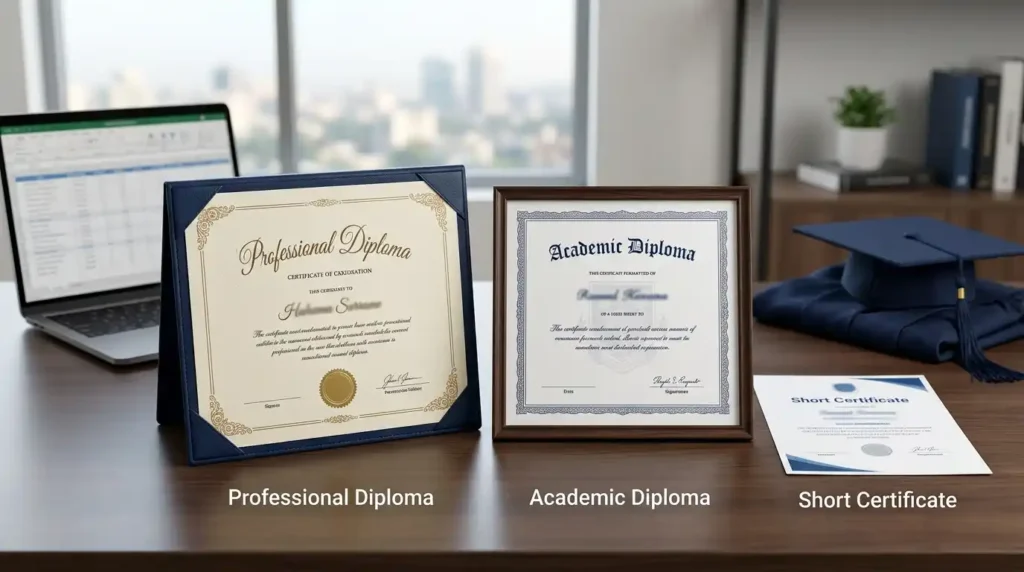
| Feature | Academic/HEC Diploma | Professional/RPL Diploma | Short Certificate |
|---|---|---|---|
| Issuing body | HEC-recognized university | Training institute/consultancy, often linked to an international awarding body | Training provider/platform |
| Typical duration | 1 year (semester-based) | 6 months to 2 years, often accelerated via RPL | Weeks to a few months |
| Entry basis | Formal academic transcripts | Can use RPL/prior work experience | Usually open enrollment |
| Recognition | Within Pakistan’s HEC-regulated framework | Recognized by the awarding body/consultancy network, not automatically by HEC/PEC/PMDC/NAVTTC/PNC | Recognized by the issuing platform only |
| Best suited for | Formal academic progression, government-regulated jobs | CV strengthening, private-sector roles, overseas job applications, internal promotion cases | Quick skill validation |
[NEEDS VERIFICATION] Exact fee ranges and durations vary by institute and by course; the figures used later in this guide reflect one provider’s (PDRI’s) published fee structure at the time of research and should be reconfirmed before you enroll anywhere.
Types of Professional Diploma Courses Available in Pakistan
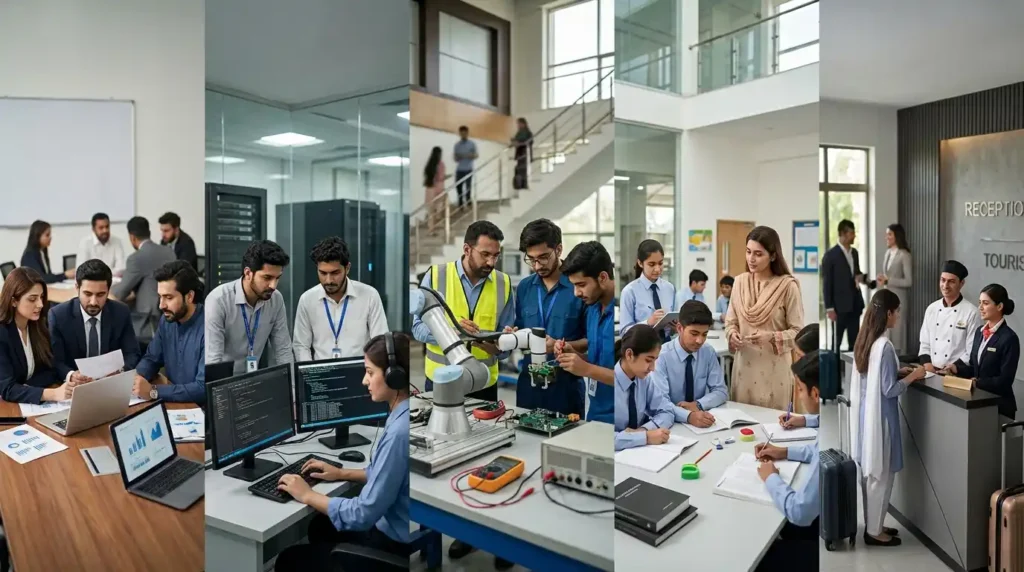
Based on published course listings, distance-learning professional diploma courses in Pakistan span a wide range of fields:
Business, Finance & Accounting
Courses such as Business and Finance Management, Human Resource Management, Sales Management, Office Administration, and Accounting and Finance are commonly offered as professional diplomas for working adults.
Engineering & Technical
Technical fields — AC & Refrigeration Technology, Civil Technology, Auto Mechanic, Electro-Mechanical Engineering, and similar trades — are typically offered on an RPL basis, meaning candidates with genuine hands-on experience in the trade can convert that experience into a certified diploma rather than starting from zero.
Information Technology
Computer Networking, Web Design and Development, Computer Science, and related IT diplomas are widely available, and in some cases are linked to government-affiliated technical training bodies at the provincial level (see the Trade Testing Board note below).
Education & Teaching
Diplomas in areas like Montessori Education, School Administration, and subject-specific teaching methods support working teachers who want a formal credential alongside classroom experience.
Hotel Management & Tourism
Programs covering Hotel Management, Housekeeping, Tourism Management, and Hotel Marketing & HRM are aimed at hospitality staff, including those already working in hotels domestically or in the Gulf.
Health & Clinical (Capacity-Building Only)
Some providers also offer continuing-education diplomas for health professionals (e.g., in family medicine, dermatology, or diagnostic ultrasound) explicitly as capacity-building, non-registering credentials — meaning they are not a substitute for PMC/PMDC registration or clinical licensing, and are intended for professional development rather than clinical practice rights. Always confirm this distinction directly with any provider before enrolling in a health-related course, since regulatory rules for clinical practice are strict and non-negotiable.
How Recognition of Prior Learning (RPL) Works for Distance Learners
RPL is the mechanism that makes many of these diplomas practical for distance learners: instead of sitting through a full academic program, a candidate with genuine, documented work experience (typically framed around a minimum period of relevant practical experience) submits evidence of that experience — job letters, project records, employer references — which is then evaluated against the diploma’s competency requirements.
For overseas Pakistanis in particular, this matters because it means:
- You don’t need to physically relocate to attend classes.
- Your years of on-the-job experience in a Gulf company can count toward the qualification.
- The process is generally faster than a full academic program, since it’s built around evaluating existing competence rather than teaching it from scratch.
[REQUIRES PDRI CONFIRMATION] The exact minimum experience threshold, required documents, and evaluation timeline should be confirmed against PDRI’s current RPL policy before publishing specific numbers.
Are Professional Diploma Courses Recognized in Pakistan and Abroad?
This is the single most important question — and the one most competitor pages avoid answering directly.
HEC, PEC, PMDC, NAVTTC and PNC — What They Do and Don’t Cover
- HEC (Higher Education Commission) attests and issues equivalence for degrees and diplomas from the Bachelor’s level upward, whether from Pakistani or foreign universities. Foreign qualifications require an HEC equivalence certificate before they can be attested.
- IBCC handles equivalence for Matric/Intermediate-level and foreign school-level qualifications.
- PEC, PMDC/PMC, NAVTTC, PNC each regulate their own professional domains (engineering, medicine, technical/vocational training, nursing) and generally require their own registration process for anyone practicing in a regulated profession in Pakistan.
Professional/RPL-based diplomas issued by training institutes and linked to international awarding bodies are generally outside these regulatory frameworks. That doesn’t make them worthless — many employers, particularly in the private sector and overseas, value them as evidence of documented skill and continuous professional development — but it does mean they should not be assumed to carry the same legal standing as an HEC-recognized university degree or a professionally regulated license.
Before enrolling anywhere, ask directly: “Is this diploma registered with HEC/NAVTTC/PEC/PMDC/PNC, or is it a professional/capacity-building credential outside that framework?” A credible provider will answer this clearly and in writing rather than deflecting the question.
What This Means for Jobs in Saudi Arabia, Qatar and Bahrain
Gulf employers and immigration authorities generally expect HEC-attested academic degrees (Bachelor’s and above) for formal qualification requirements, following the standard chain: HEC attestation → Ministry of Foreign Affairs (MOFA) attestation → destination-country embassy legalization. A professional/RPL diploma is unlikely to substitute for this chain if a specific academic qualification is mandated by an employer or a licensing body abroad.
Where a professional diploma does add value for Gulf-based professionals is as supporting evidence — for CV enhancement, internal promotion cases, or demonstrating specialized skill in a private-sector role that doesn’t require government licensing. [NEEDS VERIFICATION] Specific acceptance policies vary by employer, industry, and Gulf country, so always confirm directly with your employer’s HR department or the relevant licensing authority before relying on any diploma for a job requirement.
How Much Do Professional Diploma Courses Cost?

Based on one provider’s (PDRI’s) published fee structure at the time of research:
| Course type | Duration | Published fee | Notes |
|---|---|---|---|
| Continuing Professional Development (CPD) certificate — medical fields | 6 months | USD 200 | Diploma issued by TRACCERT Canada (stated member of the Association of Accrediting Agency Canada) |
| Professional Diploma | 1 year | USD 50 admission + USD 250 tuition (+ DHL courier charges) | Awarding body: TRACCERT Canada |
| Professional Diploma | 2 years | USD 50 admission + USD 350 tuition & exam | Awarding body: TRACCERT Canada |
| “Gold Precious” certification | Not specified | From USD 800 | Linked to GAFM |
| USA TREAC Council certificate | 1 year | USD 100 | — |
| UK UKAP qualification | Not specified | PKR 50,000 | — |
| UK HND | Not specified | USD 400 | Plus separate British Council verification (~PKR 20,000) if required |
Payment terms (as published): a minimum 30% deposit is required at enrollment, with the balance payable in up to two further installments before the certificate is issued; a 2% discount applies for full upfront payment; refunds are only available within 3 days of admission; fee concessions are available for Hafiz-e-Quran candidates, residents of tribal areas, and orphans.
[NEEDS VERIFICATION] Fees and courier/attestation costs change over time and can vary by course and destination country — always request current written fee confirmation before transferring any payment, from any provider.
How the Admission Process Works, Step by Step
- Submit an online admission form with your basic details and desired course.
- CV/experience review — your background is reviewed by an information/evaluation team (published turnaround: roughly 12–72 hours) to confirm the course fits your experience and career goals.
- Fee deposit — pay the required deposit (minimum 30%) via bank transfer to the provider’s published account, and keep the deposit slip.
- Document submission — send your deposit slip along with CNIC/passport, academic documents, and any experience letters.
- Admission acknowledgment — a computerized receipt and confirmation are issued (published timeframe: within 2 working days).
- Enrollment in the LMS — you’re registered on the Learning Management System, given assignment/research topics, and provided with study materials.
- Assignment submission and evaluation — you complete the required coursework or RPL evidence submission.
- Certificate issuance — once requirements and remaining fee installments are complete, the diploma is issued (physically and/or digitally, with online verifiability where offered).
How Overseas Pakistanis Can Enroll From Saudi Arabia, Qatar or Bahrain
Because the entire process above is designed around online forms, bank transfer, email, and an LMS, it’s built to work without visiting Pakistan in person. Practical tips for Gulf-based applicants:
- Scan and email your CNIC/Iqama, passport, and academic/experience documents in a single, clearly labeled PDF to avoid delays.
- Use the international bank transfer / IBAN details published by the provider, and always save your transfer receipt.
- Ask in writing whether your certificate will be couriered internationally (and confirm courier charges — DHL fees are mentioned separately from tuition in PDRI’s published fee structure) or issued digitally with online verification.
- Clarify attestation support in advance: most providers do not handle embassy or Ministry of Foreign Affairs attestation directly — confirm exactly who is responsible for any attestation step you may need for a specific employer.
How to Vet a Diploma Provider Before You Pay
Use this checklist with any institute offering professional diploma courses — not only PDRI:
- Ask directly whether the diploma is HEC/NAVTTC/PEC/PMDC/PNC-registered, or a professional/capacity-building credential outside that framework, and get the answer in writing.
- Ask which international awarding body actually issues the diploma, and independently look up that body.
- Request the complete, itemized fee breakdown (admission, tuition, exam, courier, attestation) before paying anything.
- Confirm the refund policy and the exact window in which you can cancel.
- Ask for verifiable proof of past graduates (verifiable reviews, online diploma verification tools) rather than relying on marketing claims alone.
- Confirm in writing what happens if attestation from HEC, MOFA, or a Gulf embassy is refused — who bears that cost.
Professional Diploma vs University Diploma — Comparison Table
| Question | Academic/HEC university diploma | Professional/RPL diploma |
|---|---|---|
| Do I need existing academic transcripts? | Usually yes | Not always — prior work experience can substitute via RPL |
| Is it HEC-regulated? | Yes | Generally no — confirm with each provider |
| Typical study format | Semester-based, structured coursework | Assignment/RPL evidence-based, self-paced |
| Best for | Formal academic progression, government-regulated roles | CV enhancement, private-sector and overseas roles, promotion cases |
| Typical timeline | ~1 academic year | 6 months–2 years, often faster via RPL |
FAQ’s
What is the difference between a professional diploma and an HEC-recognized diploma?
An HEC-recognized diploma is issued by a university within Pakistan’s formal, regulated qualifications framework. A professional diploma is typically issued by a training institute or consultancy, often linked to an international awarding body, and sits outside that HEC framework — it’s generally used for skills documentation and CV enhancement rather than as a legally regulated academic qualification.
Can I complete a professional diploma course entirely online while working in Saudi Arabia, Qatar, or Bahrain?
Yes, in most cases. The admission form, fee payment, document submission, coursework/RPL evidence, and even certificate delivery can typically be handled remotely through email, bank transfer, and an online LMS, without visiting Pakistan.
Will my professional diploma be accepted by HEC or a Gulf employer?
This depends entirely on the specific diploma and the specific employer or authority. Professional/RPL diplomas are generally not automatically equivalent to HEC-attested academic degrees. Always confirm directly with the relevant employer, licensing body, or embassy before relying on any diploma to meet a formal requirement.
How does Recognition of Prior Learning (RPL) work?
RPL allows a candidate to submit evidence of genuine, relevant work experience (job letters, project records, employer references) instead of, or alongside, formal academic transcripts. That evidence is evaluated against the diploma’s requirements, which can shorten the time needed to earn the qualification.
How much do professional diploma courses cost?
Costs vary by field, duration, and awarding body. As one example, a provider’s published 2026 fee structure showed a 1-year diploma at roughly USD 300 total (admission + tuition) plus courier charges, with installment payment options. Always request current, written fee confirmation from any specific provider before paying.
What documents do I need to enroll?
Typically: CNIC/passport copy, academic documents, and any relevant experience letters or job references (especially for RPL-based courses).
Is a professional diploma useful if I already have a Bachelor’s or Master’s degree?
many professionals it functions as a specialization or continuing-professional-development credential layered on top of an existing degree, rather than a replacement for it.
How do I check if a diploma-awarding institute is credible?
Ask directly whether the diploma is regulated by HEC/NAVTTC/PEC/PMDC/PNC or issued outside that framework; verify the international awarding body independently; request an itemized fee breakdown and refund policy in writing; and look for an online diploma-verification option.